
Music Licensing for Video: What You Can Legally Use (2026)
Three weeks after you publish, a claim appears. The track came from a library you paid for, the receipt is in your inbox, and a rights holder you have never heard of is now collecting the ad revenue from that video. Nothing is broken. That’s how the system was built, and it’s why music licensing is mostly a filing habit.
This guide covers the paperwork side of music, not the mixing side. Which permissions a video needs, where to find tracks you can point to a year later, and what to do when a claim lands anyway. No software to install, no download step, and no promise that any of it resolves itself.
Music licensing for video comes down to two permissions per track, and most creators secure only one. The gap between them is where claims live.
The Direct Answer: You Need Permission for Each Track You Use
If someone else wrote and recorded the music, you need their permission to put it in your video. That’s the whole rule, and most music licensing guides bury it under caveats. Everything below is detail about who to ask, what the permission has to say, and how to prove you have it.
Music bundled with editing software or a phone is usually licensed for personal use only. A song in a game, a film, or a friend’s playlist carries no permission for your video at all. Neither does a track you found on a streaming service, even when the artist is small and the upload earns nothing.
Music Licensing for Video: The Two Rights Behind Every Track
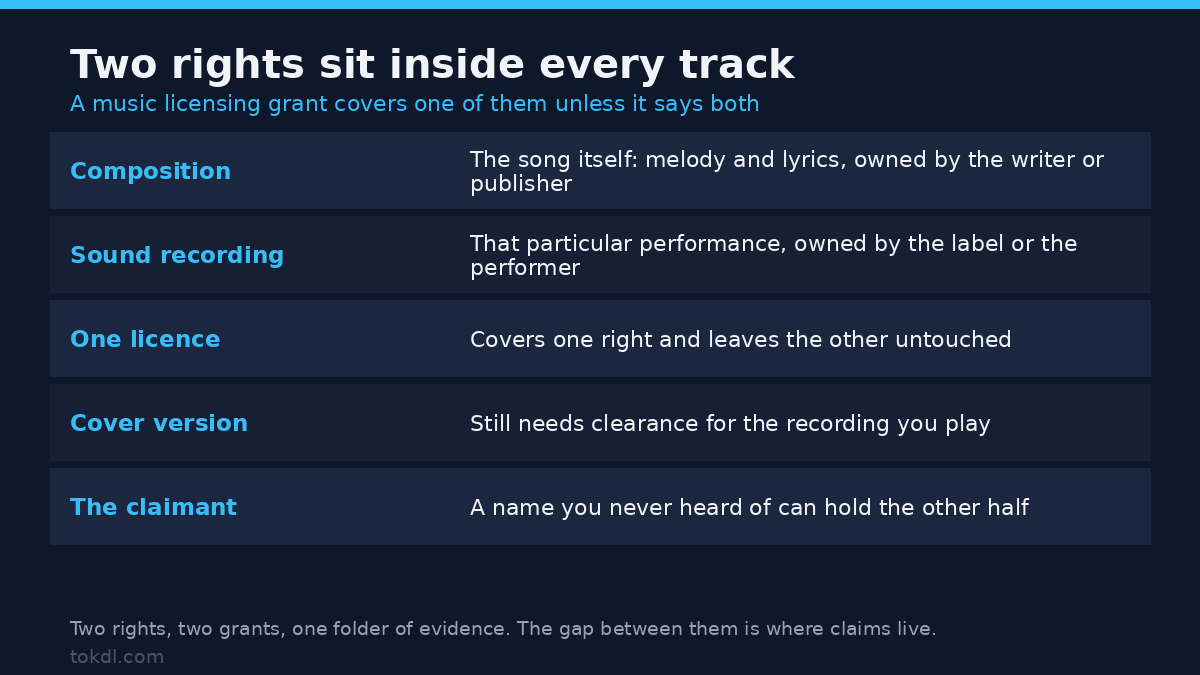
Every commercial recording carries two separate copyrights. The composition is the song itself, the melody and lyrics, owned by the writer or their publisher. The sound recording is that particular performance, owned by the label or the performer. A licence for one doesn’t touch the other, and that’s where most music licensing mistakes start.
This is why a cover version still needs clearance. You can hold the publishing rights for a song and have no right at all to the master recording you found online. It’s also why a claim can arrive from a name that means nothing to you: the claimant holds one of the two rights, and you were only ever given the other.
Music licensing grants are narrow by design. They name the platform, the territory, the duration, and whether money is involved. A track cleared for a personal YouTube upload covers that upload alone, not a client’s advert, a TikTok repost, or a version you later sell. Read those four clauses before you place the track.
Three Questions to Answer Before You Pick a Source
Answer these three questions before you open a music library, because the answers eliminate most of the options on their own. They take about a minute, they decide which of the routes below you can actually use, and they’re the cheapest music licensing audit you can run.
Where will the video live? One platform, or five? A platform library is the cheapest route and the least portable. A YouTube licence covers YouTube and nothing else, so if you’re reposting the same clip to three apps, read all three sets of terms.
Is money involved? Monetised channels, sponsored videos, and anything delivered to a client count as commercial use. Most free licences exclude it, and the exclusion usually applies to the whole account rather than to the single video that earns.
Can you produce the licence in twelve months? Keep the receipt, the certificate, and the track page as it looked on the day you downloaded. Pages change, libraries close, and a dated copy from the right week settles most disputes.
Method 1: Platform Libraries, Free but Platform-Locked
YouTube’s Audio Library sits inside YouTube Studio and is free for anyone with an account. Tracks are filterable, and the filter that matters in music licensing is attribution. Some tracks require a credit line in your description, and leaving it out voids the permission. The library supplies the exact text to paste.
Meta’s Sound Collection covers Facebook and Instagram, and TikTok’s Commercial Music Library is aimed at business accounts. Both are licensed for use inside their own platform. Pull the same audio into a video for LinkedIn or your own website and the music licensing you had inside the app doesn’t carry over.
The trade-off is real, and it shapes every music licensing decision. You get cleared music at no cost and no paperwork, and in exchange the video is tied to one company’s terms, which can change without your involvement. Check the current help pages before you build a series around a single track.
Method 2: Creative Commons and Public Domain Sources
Creative Commons licences are public grants, and each one sets different conditions. CC0 waives rights almost entirely. CC BY requires attribution in the form the licence specifies.
The other two letters matter as much in music licensing. A licence containing NC excludes commercial use, which rules out a monetised channel. SA means adaptations have to carry the same licence.
Sources worth knowing include Free Music Archive, Musopen for classical recordings, the Internet Archive, and Wikimedia Commons. Each is a mixed bag for music licensing: the licence on the file page governs, not the reputation of the site.
Treat every CC file as unverified until you check who uploaded it. People upload music they do not own, and a licence is only as good as the rights of the person granting it. Save the licence text, note the uploader, and keep both.
Public domain needs the same care for a different reason: music licensing does not end where copyright does. An old composition can be free of copyright while a modern recording of the same piece stays fully protected. The score is public domain; the orchestra playing it is not.
Method 3: Pay for a Licence You Can Prove
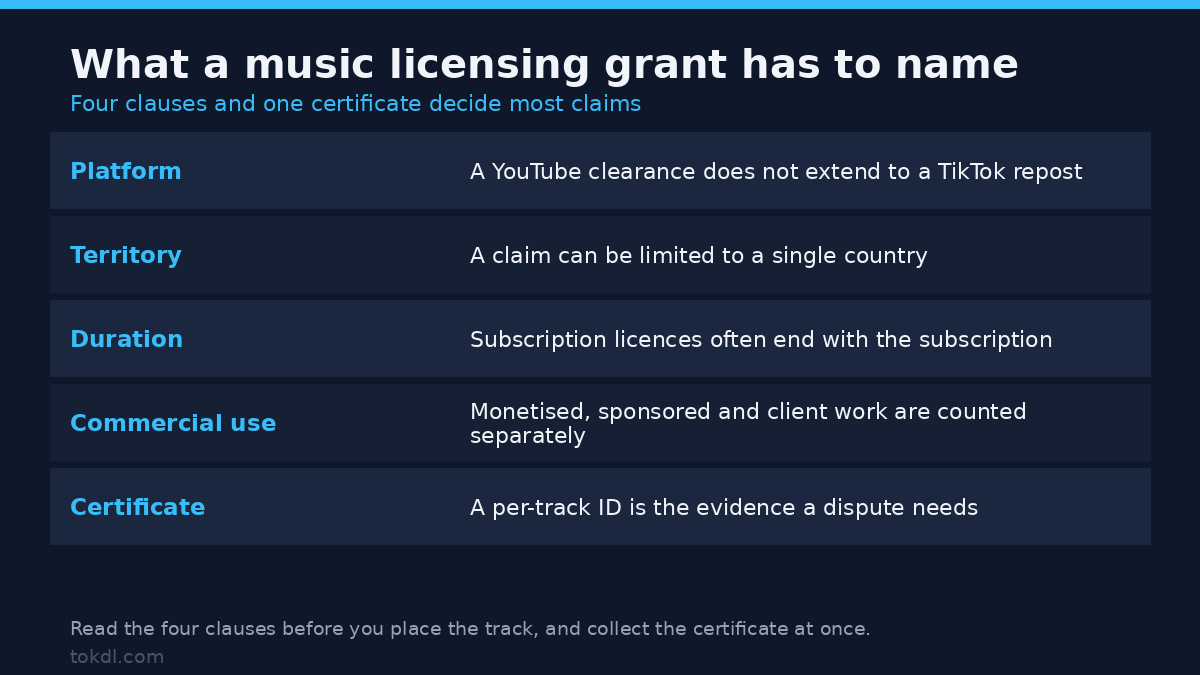
Subscription libraries sell blanket access, usually for a monthly fee, sometimes per track. The differences that matter in music licensing have nothing to do with the price. Look for five things: the list of platforms covered, whether monetised channels and client work are included, whether the library whitelists your channel so automated claims skip it, what happens to published videos if you cancel, and whether the certificate names your project.
Every reputable library issues a per-track certificate with an ID number: that certificate is what you’re paying for in music licensing. Download it at the moment you download the audio, not later. File it in a folder named after the video, beside the project file. When a claim arrives eighteen months on, that folder is the difference between a five-minute dispute and a re-edit.
Clearing a track settles only the legal question. Making it sit under speech without swallowing the dialogue is a separate problem, and music bed levels follow their own rules once the paperwork is done.
Music licensing for video gets easier once you stop thinking about tracks and start thinking about evidence. A cheap track with a clean certificate beats an expensive one you can’t document.
What Content ID Does, and What It Cannot Do
YouTube’s Content ID fingerprints audio and video, then compares new uploads against files supplied by rights holders. When it matches, it applies a claim. The claim usually redirects the video’s revenue to the claimant, and in some cases blocks the video in specific countries.
A claim isn’t a strike. Strikes come from formal takedown requests and carry account penalties. A claim is a monetisation decision, and you can dispute it. Confusing the two leads creators to delete videos they were entitled to keep.
The system can’t read your music licensing paperwork. It matches audio, not intent, so a properly licensed track gets claimed whenever the library never registered your channel or your particular use. That’s a routine outcome rather than evidence of wrongdoing. It’s also why the certificate matters more than the receipt email.
Rights and Responsible Use
The music belongs to the people who wrote and performed it. A music licensing grant rents you specific uses; it doesn’t transfer ownership, and it doesn’t make the track yours to license onward. Paying a subscription grants access to a catalogue, not rights over it.
Playing a track in a private edit or for your own reference is one thing. Publishing it, monetising it, or handing it to a client is another, and each of those needs its own permission. Obtaining a file, however you obtained it, gives you nothing beyond the copy in your hand.
Re-uploading someone else’s track as your own audio is redistribution, with or without a credit. A disclaimer in the description doesn’t convert an unlicensed use into a licensed one. YouTube’s own rules are short and worth reading once: YouTube’s Terms of Service state what uploading grants and what it withholds.
Troubleshooting: Six Claims You Will Actually See
A claim appeared on a track from a paid library
The library hasn’t whitelisted your channel, or the claim came from a distributor representing the same recording. Send the certificate through the dispute form and quote its ID. Most libraries also accept whitelist requests, which stop future claims before they start.
The claim only applies in one country
Content ID policies are set per territory, and a rights holder may control a single market. The video stays visible where you publish and shows as blocked elsewhere. Read the claim details before assuming the whole upload is gone.
My own recording was claimed
Someone registered the same audio, often through a distributor that ingested your track without permission. Dispute with the project file, the raw stems, and the export date. Keep it factual: you’re asserting authorship, not negotiating.
A disclaimer in the description did not help
Writing that no infringement was intended carries no legal weight, and it shows you knew the material was someone else’s. Fair use exists as a defence argued after a dispute and weighed on four factors; the Copyright Office index is the plainest summary of it. Either license the track or replace it, because there’s no music licensing trick that turns a disclaimer into permission.
The CC track turned out to be mislabelled
The uploader didn’t own what they licensed, so your permission is only as strong as their rights and the claim stands. Replace the audio, keep the evidence of the original licence page, and report the file to the host so the next creator avoids it.
A game soundtrack got claimed despite the publisher’s policy
Publisher policies usually permit gameplay footage that happens to contain in-game music. They rarely permit lifting that soundtrack into an unrelated video. The distinction is whether the music is incidental to the footage or the point of it, and that’s a music licensing question only the publisher can answer.
Frequently Asked Questions
What does music licensing for video mean in practice?
It means holding permission for both the song and the recording before you publish. Two rights, two grants, one folder of evidence.
Is royalty-free the same as copyright-free?
No. Royalty-free means you pay once instead of per play. The track remains copyrighted, and its licence still sets limits on where and how you use it.
Is YouTube Audio Library music free to use anywhere?
No. It’s licensed for YouTube. Using the same track in a video for another platform or a client usually falls outside that licence.
Does crediting the artist make an unlicensed use legal?
No. A credit satisfies an attribution licence and nothing more. Without a licence, a credit changes nothing about the rights involved.
What should I do when a Content ID claim arrives?
Read it before you react. The claim names the claimant, the matched segment, and the policy applied. If you hold a licence, dispute it and attach the certificate. If you don’t, remove or replace the audio.
Can I use a game’s soundtrack in my video?
Only inside the publisher’s stated permission. Gameplay footage with music in the background is commonly allowed; the isolated soundtrack is a different asset and usually is not.
How long does a music licence last?
For as long as its terms state, and no longer. Subscription licences often end with the subscription, which is why the cancellation clause matters before you commit to a series.
Do I need a licence if the video earns nothing?
Usually yes, but the licence still applies. Free licences tend to exclude commercial use, and publishing someone’s music without permission is an unauthorised use whether or not money changes hands.
Which Route Fits Your Video?
If the video lives on one platform and you want no paperwork, use that platform’s library and accept the lock-in as the price of clean music licensing. If it has to work across several platforms or for a client, buy from a library that issues certificates and whitelists channels, then keep the paperwork.
If the budget is zero and the reach is small, Creative Commons is workable, provided you check the licence on the file page and credit exactly as asked. For a private project that will never be published, none of this applies and you can use whatever you like.
Music licensing for video is mostly a record-keeping habit. The creators who avoid trouble tend to be the ones who can produce a certificate in under a minute.