
Noise Gate Settings: Cut Room Tone Without Cutting Words
The hiss in your recording is louder than the quietest line of dialogue. So you add a noise gate, the room goes dead between phrases, and that quiet line vanishes with it. I’ve done that more than once, and the fix was never a better threshold. It was knowing which of the gate’s six numbers decides which half of the problem.
This guide is measured, not a settings list. I built a 16-second test file: a loud voice-like burst at -13.4 dBFS RMS, a quieter one at -19.4, a faint passage at -45.5, and a steady white-noise bed at -50.0 dBFS. Every setting below went through FFmpeg 7.1.5’s agate filter and was measured window by window.
If you’re chasing a reverb tail rather than steady hiss, removing echo already measures that case. If the noise sits under the speech, no gate touches it, which is why background noise removal is a separate job. This piece covers steady room tone between phrases, and what removing it costs.
What you’ll learn
- Which number decides whether a quiet word survives.
- How to measure your own gap before picking a threshold.
- When a denoiser beats a noise gate.
What each noise gate control decides
The filter is a downward expander with six numbers that matter.
Threshold is where gain starts to drop. It’s stored as a linear amplitude from 0 to 1, so threshold=0.01 means -40 dBFS and threshold=0.03 means about -30.5 dBFS. You can also write threshold=-40dB and FFmpeg converts it. What you can’t write is a bare threshold=-40: the filter rejects it with Numerical result out of range and exit code 222, which reads like a broken file rather than a unit mistake.
Knee, 2.83 dB by default, softens the corner, and it matters more than the manual suggests. At -48 dBFS, knee=1 changed my room tone by 0.00 dB while knee=8 dropped it the full 24.25 dB: a wide knee starts the noise gate closing above the threshold, not at it.
Ratio is the slope under the threshold, and range is the floor: the most gain reduction the filter applies, as a multiplier. The default range is 0.06125, a 24.2 dB ceiling. Set range=1 and the noise gate does nothing at all.
Attack and release are time constants in milliseconds. There’s no hold control in FFmpeg’s version, unlike the gate in OBS, so nothing keeps it open through a short pause. That missing control explains most of the pumping you’ll hear.
Measure the gap before you pick a threshold
Two measurements decide everything: the room tone between phrases and the quietest speech you want to keep. On my fixture they read -50.0 and -45.5 dBFS, a 4.5 dB window.
ffmpeg -ss 2.6 -t 0.5 -i input.mp4 -af volumedetect -f null -
ffmpeg -ss 1.2 -t 0.6 -i input.mp4 -af volumedetect -f null -
The first reports mean_volume: -50.2 dB, the second mean_volume: -13.4 dB. Find the windows by ear first. If your quietest word sits within 6 dB of the room tone, stop: a noise gate can’t tell it from room tone, and the next table shows why.
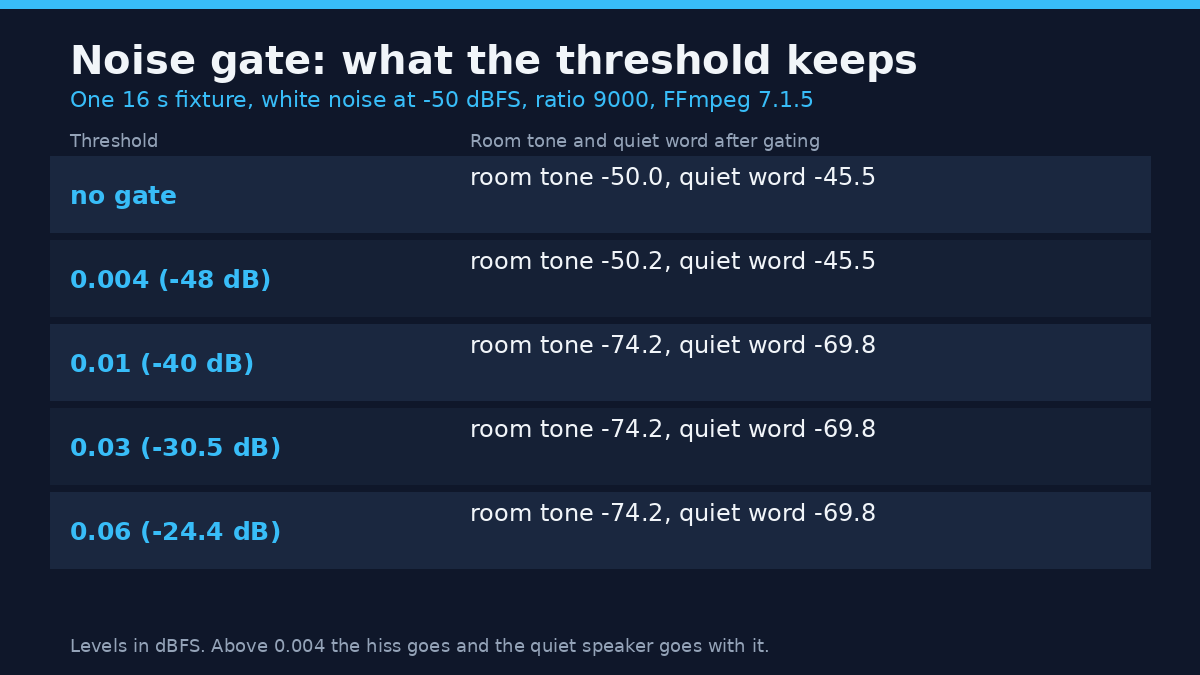
What the threshold keeps and what it deletes
Six runs, ratio 9000, everything else at default. Columns: the gap between phrases, the -45.5 dBFS passage, the -13.4 dBFS burst.
| Threshold | Room tone in gaps | Quiet word (-45.5) | Loud word (-13.4) |
|---|---|---|---|
| no gate | -50.0 dBFS | -45.5 dBFS | -13.4 dBFS |
| 0.003 (-50.5 dB) | -50.0 dBFS | -45.5 dBFS | -13.4 dBFS |
| 0.004 (-48 dB) | -50.2 dBFS | -45.5 dBFS | -13.4 dBFS |
| 0.01 (-40 dB) | -74.2 dBFS | -69.8 dBFS | -13.4 dBFS |
| 0.03 (-30.5 dB) | -74.2 dBFS | -69.8 dBFS | -13.4 dBFS |
| 0.06 (-24.4 dB) | -74.2 dBFS | -69.8 dBFS | -13.4 dBFS |
The first three rows are the trap: the noise gate changed nothing and still exited cleanly, because a threshold under the room tone can’t gate room tone. The last three show the trade: once the threshold rises above the quiet passage, that passage falls 24.2 dB and stops being audible, while the loud burst doesn’t move by a hundredth of a decibel. No row has the hiss gone and the quiet speaker intact.
Raising it past a point buys nothing either: once a signal sits a few dB under the threshold, the noise gate is at its floor, so 0.06 performs exactly like 0.01. If room tone is still audible, the range is your problem, not the threshold. A noise gate doesn’t know which sound is a person.
Range sets how far down the gate goes
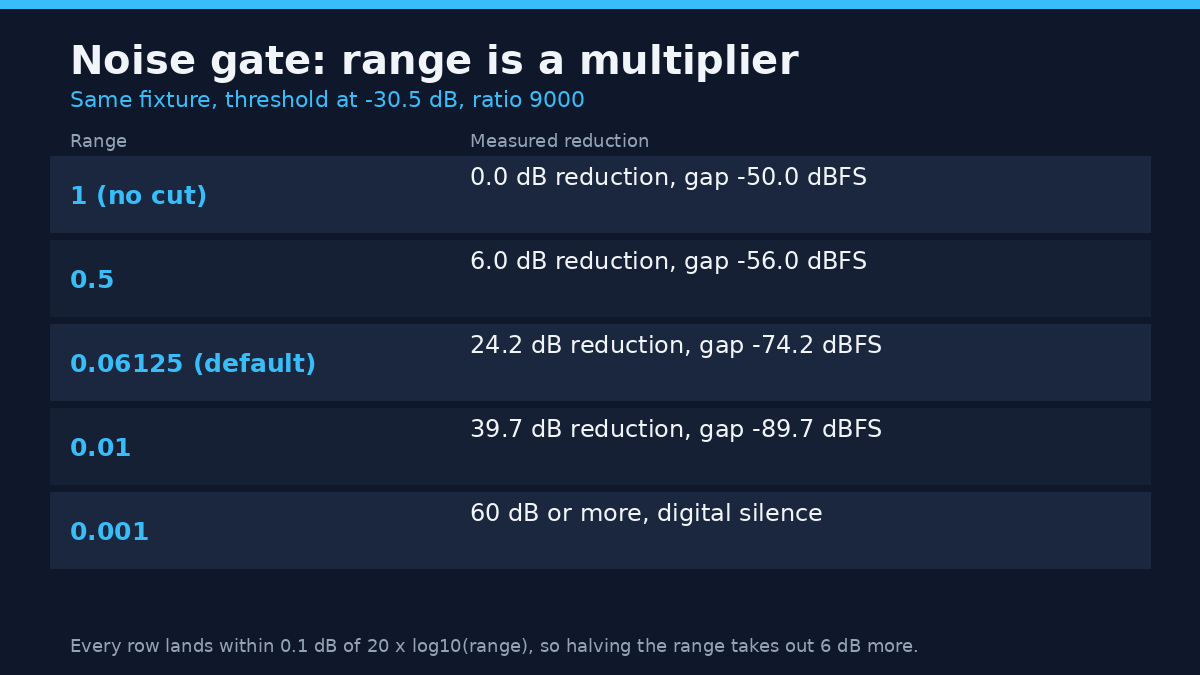
Range is the ceiling on attenuation, and it behaves like a plain multiplier. Measured against a -50 dBFS gap with the threshold at -30.5 dB:
| Range | Gap after gating | Reduction |
|---|---|---|
| 1 (no reduction) | -50.0 dBFS | 0.0 dB |
| 0.5 | -56.0 dBFS | 6.0 dB |
| 0.06125 (default) | -74.2 dBFS | 24.2 dB |
| 0.01 | -89.7 dBFS | 39.7 dB |
| 0.001 | silence | 60 dB or more |
Every row lands within 0.1 dB of 20 x log10(range), so halving the range takes another 6 dB out. The last row is digital silence, which sounds wrong on a voice track: noise cutting in and out of absolute nothing is the giveaway that a noise gate is running. Keep a floor near -60 dBFS.
Release decides how much noise walks back in
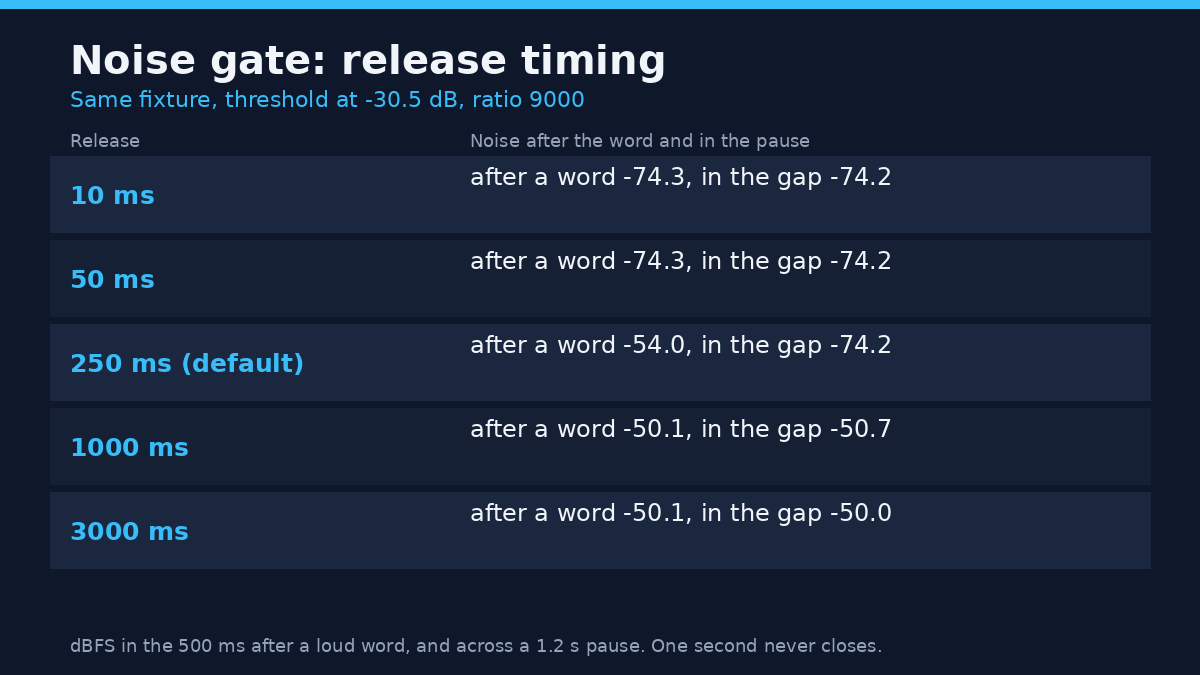
Release is how long the gate takes to close after the signal drops. Too short chops word tails; too long never shuts between phrases, the failure I see most in tutorials. Noise in the 500 ms after a loud word, and across a 1.2-second gap:
| Release | 500 ms after a word | 1.2 s gap |
|---|---|---|
| 10 ms | -74.3 dBFS | -74.2 dBFS |
| 50 ms | -74.3 dBFS | -74.2 dBFS |
| 250 ms (default) | -54.0 dBFS | -74.2 dBFS |
| 1000 ms | -50.1 dBFS | -50.7 dBFS |
| 3000 ms | -50.1 dBFS | -50.0 dBFS |
At 250 ms the gate has closed before the next phrase, but the first quarter second after each word is still 20 dB noisier than the silence. At a full second it never closes inside a 1.2-second pause, so the file sounds like nothing happened: set a one-second release on a speaker who pauses for half a second and you’ve built a noise gate that only works at the end of paragraphs.
Short is safer: ten milliseconds catches the end of a word without a click, because the gain change is a ramp, not a cut. If tails get clipped, raise it to 100 or 150 ms.
Attack, and the quiet first syllable
Attack gets blamed for chopped word starts, and on a hard onset that blame is misplaced: at a -30.5 dB threshold, 1 ms and 1000 ms differed by 0.7 dB on the first 60 ms of the loud burst. A loud consonant punches through the detector whatever the attack.
Softer starts differ. With a 400 ms fade-in, attack=1 opened the noise gate within 50 ms; attack=20 held the first 50 ms 24.3 dB down and opened at 100 ms; attack=300 kept the hole for 150 ms. A word that eases in loses its beginning, and no threshold change fixes that.
A noise gate against a denoiser
A gate is a switch; a denoiser is a filter. On the same clip, afftdn=nr=12 took the room tone from -50.2 to -60.5 dBFS, about 10 dB, everywhere, including under the loud word, where you can’t hear the change because the noise was 37 dB below the voice. The quiet word moved 1.7 dB, since most of the meter’s reading there is noise.
That’s the decision. Use the denoiser when the hiss sits under the speech, the noise gate when it only bothers you between phrases. In that order the pair measured -90.4 dBFS in the gaps. Run the denoiser first, then the gate, then re-measure: the threshold is set against the noise level, so removing 10 dB of hiss moves the number you need.
ffmpeg -i input.mp4 -c:v copy -af "afftdn=nr=12:nf=-50" -c:a aac -b:a 192k cleaned.mp4
ffmpeg -i cleaned.mp4 -c:v copy -af "agate=threshold=0.01:ratio=20:range=0.03:attack=5:release=120" -c:a aac -b:a 192k gated.mp4
The first command kept the loud word at -13.4 dBFS and put the gaps at -60.5; the second, on that cleaned file, pushed the gaps to -90.4 and the quiet passage to -77.7, leaving the loud word at -13.4. If that passage matters, lower the threshold until it survives and accept a shallower noise gate, or skip it and let the denoiser work. The filter reference lists every option beyond the six here.
Six mistakes that make a noise gate sound worse
Typing a bare decibel value. threshold=-30 fails with exit code 222. Write -30dB or the linear form 0.03.
Leaving range at the default. The default noise gate ceiling is 24.2 dB, so a -30 dBFS room tone lands at -54 dBFS, still audible under dialogue.
Copying a threshold from a forum. A recipe built around threshold=-15dB took 10.4 dB out of my -19.4 dBFS speaker and left the loud one untouched. Thresholds are levels, and levels differ per recording.
Setting a release longer than the pauses. At 1000 ms the noise gate never closed inside a 1.2-second gap, and the room tone measured -50.7 dBFS, the ungated level.
Using a gate where a denoiser belongs. Under speech it doesn’t do anything: the loud word measured -13.38 before and after. The hiss you hear during a sentence is a job for noise reduction.
Reaching for silence removal instead. silenceremove rewrote my 16-second file to 6.44 seconds, because it deletes the pauses rather than muting them. Cutting dead air changes the timeline; a gate doesn’t.
And one that costs an afternoon: gating before you normalise. Normalising the audio moves every level, including the ones your threshold was set against, so the gate that worked in the edit lands wrong. Normalise, then set the threshold, then gate. A compressor goes before the gate for the same reason: it changes the gap between loud and quiet.
FAQ
Does a noise gate remove background noise?
Only between phrases. Under a loud word it changed nothing, because the signal never dropped below the threshold. A denoiser such as afftdn cut the same hiss by about 10 dB everywhere, at the cost of 1.7 dB on the quietest passage.
What’s a good noise gate threshold?
One value between your room tone and your quietest word, measured on your own file. On my fixture that window was 4.5 dB wide; any threshold that silenced the hiss also cut the quiet passage 24 dB. A wide gap makes the job easy, a narrow one means a noise gate can’t do it cleanly.
Is a noise gate the same as an expander?
An expander is the general case and a gate is its extreme setting. At a ratio of 1.5 the room tone dropped 1.2 dB; at 4 it dropped 7.3; at 20 it hit the 24.2 dB range ceiling. Ratios under about 4 sound like gentle expansion, higher ones like a switch.
Can I use a noise gate on music?
Rarely. A continuous bed doesn’t fall below the threshold, so a gate run on a clip with a steady -20 dBFS music bed changed the level by 0.00 dB. Gates need pauses.
Why does my audio pump after gating?
Because the gate keeps reopening on noise between syllables. FFmpeg’s noise gate has no hold control, so the fix is a shorter release, a wider knee or a smaller range. If the pumping survives that, the pauses are too short and the material wants a denoiser.
The short version
Set the threshold from two measurements, not from a forum post: your room tone and your quietest word. Keep the range near 0.03 if you want a real 30 dB of silence, set the release under your shortest pause, and keep the attack around 5 to 20 ms. Then check the quiet passage again. If it disappeared, the gap was never wide enough for a noise gate, and the honest answer is a denoiser, or a better recording.