
Stereo Widening in FFmpeg: Add Width Without Breaking Mono
Why the wide mix collapses on a phone speaker
You finish a mix on headphones, the pad feels huge, the guitar sits outside the vocal, and everything has room. Then you check it on your phone and half that width is gone. Nothing is broken. A phone speaker plays one channel, so it hears the sum of left and right, and stereo widening lives in what the two channels disagree about. Push that disagreement far enough and the sum gets thin, phasey, or quieter than what you started with.
This article is about stereo widening in FFmpeg, measured on one fixture so the numbers can be checked rather than trusted. The fixture is a ten second 48 kHz stereo file: a centre at 220 and 440 Hz, a left-only tone at 330 Hz, a right-only tone at 770 Hz. Its correlation and side level can be predicted on paper. The prediction was 0.5814 correlation and -5.77 dB of side against mid; the baseline measured 0.581 and -5.77 dB, which is why the rest of the table is worth reading.
What you’ll learn
- What stereo widening changes, in measurable mid and side terms.
- How
extrastereobehaves as a width control, and why its default clips. - Why
stereowidencombs the mono sum instead of moving sounds outward. - The fold-down numbers that say when the width went too far.
What stereo widening changes
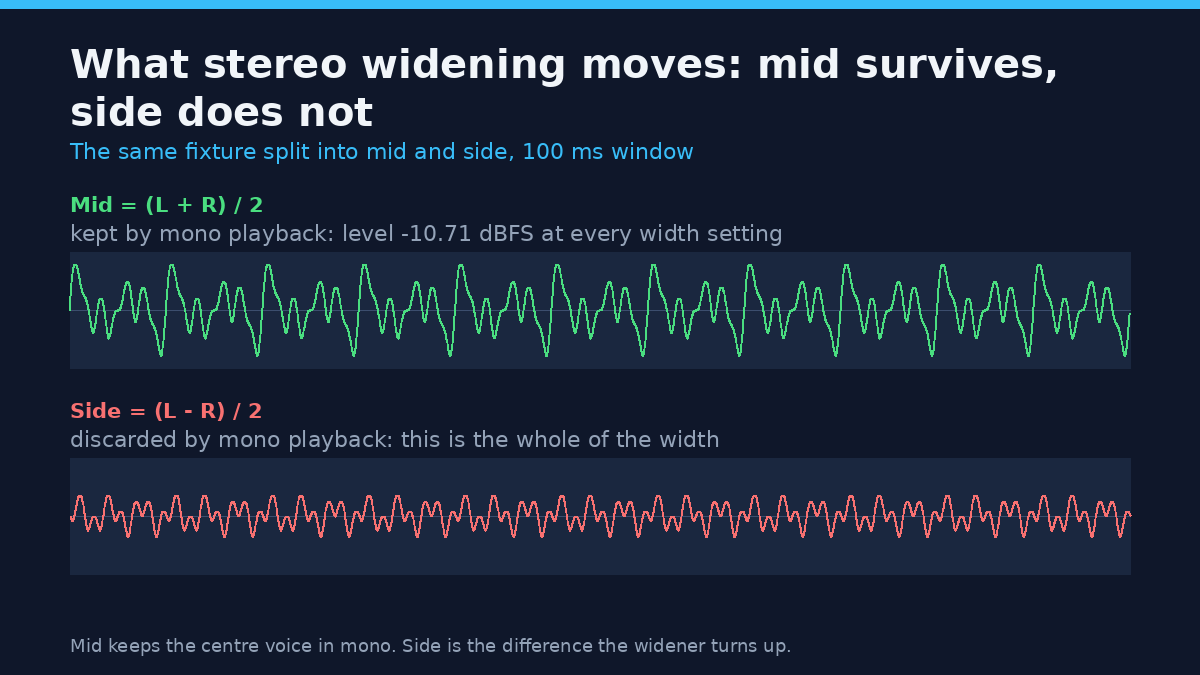
Every stereo file splits into a mid channel, both channels added and halved, and a side channel, left minus right halved. The mid carries what both speakers reproduce, so it survives mono playback. The side carries the difference, and mono playback throws it away. Stereo widening works by raising the side channel against the mid, using a matrix, a short delay, or both.
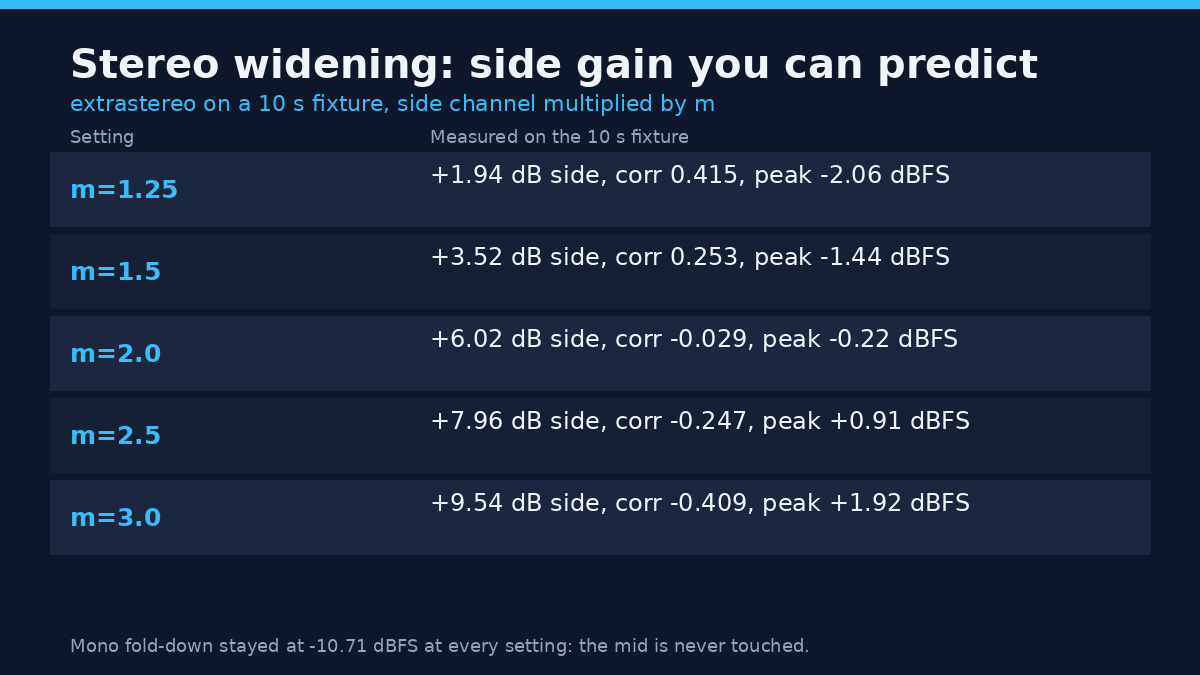
FFmpeg’s extrastereo does the honest version. Its m option multiplies the side channel and leaves the mid alone. Measured on the fixture, the side tones at 330 Hz and 770 Hz went from 0.15 to 0.225 at m=1.5 and to 0.375 at m=2.5, which is 1.5 and 2.5 times the original. The 220 Hz and 440 Hz centre tones stayed at 0.25 at every setting, and the mono sum measured -10.71 dBFS at every setting too.
That last number matters more than it looks. A matrix widener doesn’t make the mono fold-down quieter, because the mid is untouched. It changes the phase relationship between the channels instead, which shows up as correlation dropping, then crossing zero, then going negative. A negative correlation means the channels push in opposite directions, and a mono fold-down is where you hear it as cancellation inside the sound rather than a loss of level.
| Width setting | Side gain | Correlation | Mono level | Peak |
|---|---|---|---|---|
| source | 0.00 dB | 0.581 | -10.71 dBFS | -2.65 dBFS |
m=1.25 |
+1.94 dB | 0.415 | -10.71 dBFS | -2.06 dBFS |
m=1.5 |
+3.52 dB | 0.253 | -10.71 dBFS | -1.44 dBFS |
m=2.0 |
+6.02 dB | -0.029 | -10.71 dBFS | -0.22 dBFS |
m=2.5 |
+7.96 dB | -0.247 | -10.71 dBFS | +0.91 dBFS |
m=3.0 |
+9.54 dB | -0.409 | -10.71 dBFS | +1.92 dBFS |
m=4.0 |
+12.04 dB | -0.618 | -10.71 dBFS | +3.69 dBFS |
The side gain column isn’t a curve fit. It’s 20 times the log of m at every setting tested. Want 6 dB more width? Ask for m=2 and you get 6.02 dB of side. Want 3 dB? Ask for 1.41.
Method 1: stereo widening with extrastereo
The useful command turns the clipping off explicitly. FFmpeg ships extrastereo with clipping enabled by default, and the option is called c.
ffmpeg -y -i input.wav -af "extrastereo=m=1.5:c=0" -c:a pcm_s24le wide.wav
ffmpeg -y -i input.wav -af "volume=-4.3dB,extrastereo=m=2.5:c=0" -c:a pcm_s24le wide2.wav
On this fixture the default clipped version pinned its peak at exactly 0.00 dBFS, with 60,200 of 960,000 output samples at full scale, so 6.3 percent of the file was flattened against the ceiling. Turning clipping off doesn’t remove the overload, it stops hiding it: with c=0 at m=2.5, 59,800 samples sat above full scale and the peak measured +0.91 dBFS. The peak climbs about 0.6 dB at m=1.25, 1.2 dB at m=1.5 and 2.4 dB at m=2.0, exactly what you’d expect once the side channel is amplified.
So stereo widening needs headroom in front of it. The second command takes 4.3 dB off first and widens at 2.5, and the delivered peak lands at -3.39 dBFS with nothing over full scale. A limiter after the widener also works, but only with the right flag: alimiter=limit=0.9:level=false delivered a -0.92 dBFS peak, while the default level=true handed the level back and re-normalised the file to 0.00 dBFS, the opposite of what the limit was for. There’s a longer treatment in the guide to setting a limiter ceiling that holds.
Method 2: stereo widening with stereowiden
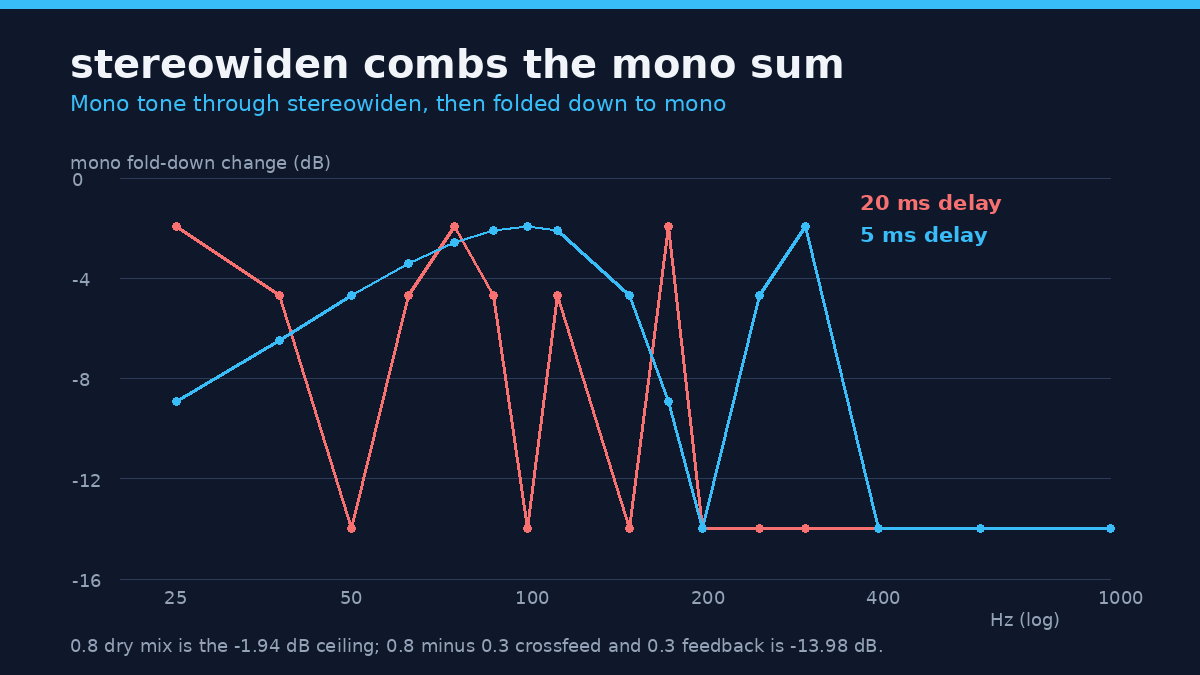
stereowiden takes a different route. It delays one channel against the other, feeds a little back, and crossfeeds a portion into the opposite side. The width comes from that short delay, which is also why it can wreck the mono sum. With the default 20 ms delay, a mono tone played through it and folded down to mono loses 13.98 dB whenever the tone sits at a whole multiple of 50 Hz, and never gets better than -1.94 dB in between.
| Tone frequency | Mono sum, 20 ms delay | Mono sum, 5 ms delay |
|---|---|---|
| 25 Hz | -1.94 dB | -8.93 dB |
| 50 Hz | -13.98 dB | -4.69 dB |
| 75 Hz | -1.94 dB | -2.58 dB |
| 100 Hz | -13.98 dB | -1.94 dB |
| 150 Hz | -13.98 dB | -4.69 dB |
| 200 Hz | -13.98 dB | -13.98 dB |
| 400 Hz | -13.98 dB | -13.98 dB |
| 1000 Hz | -13.98 dB | -13.98 dB |
The pattern isn’t random, and the arithmetic is short. A 20 ms delay puts the delayed copy back in phase every 50 Hz, where the 0.8 dry mix minus the 0.3 crossfeed and the 0.3 feedback leaves 0.2, which is -13.98 dB. Between those points the delayed copy is antiphase, the wet path cancels, and only the 0.8 dry mix survives at -1.94 dB. Halve the delay to 5 ms and the damage moves to every 200 Hz, which is why the 200 Hz row onward reads the same as before.
On the full fixture, with real side content, stereowiden at its defaults dropped the mono fold-down by 3.4 dB and left a correlation of 0.387. Its RMS also came out 2.8 dB lower, which is the filter’s dry mix, not the width. For stereo widening as an audible effect on a sound design element, that comb is the character. For a vocal that has to survive a phone, it isn’t the tool.
Method 3: manual stereo widening with pan
The pan filter gives you the same stereo widening arithmetic with a number you choose, and the mono result is predictable to a tenth of a decibel. Subtract a fraction of the opposite channel from each side and you raise the difference:
ffmpeg -y -i input.wav -af "pan=stereo|c0=c0-0.3*c1|c1=c1-0.3*c0" -c:a pcm_s24le wide.wavBoth channels keep their own content and lose the same fraction of the other, so the mono sum scales by one minus that fraction. At 0.3 I predicted -3.10 dB and measured -3.09 dB; at 0.15 I predicted -1.41 dB and measured -1.41 dB. That’s a more honest trade than stereowiden, because you see the price before you render. The catch is that it narrows material that was already wide.
How much stereo widening is too much
The correlation reading is the control that matters, and it’s cheap to check. Sum the file to mono with pan=mono|c0=0.5*c0+0.5*c1 and listen for anything that vanished. In the measurements, correlation went 0.581 at the source, 0.253 at m=1.5, -0.029 at m=2.0 and -0.247 at m=2.5. Once it crosses zero the channels work against each other, and stereo widening then hollows the sum out.
A practical floor for anything with dialogue or a lead vocal is about 0.2, which on this fixture means staying at or below m=1.5. Music beds and effects can go further, but only after you’ve checked the mono sum. The site’s own guide to stereo to mono downmixing covers the other half of this problem, and for a surround source the 5.1 downmix guide is the one to read first.
| What you’re widening | Setting | Check before you export |
|---|---|---|
| Dialogue or a lead vocal | m=1.25 to m=1.5, c=0 |
correlation above 0.2, peak under -1 dBFS |
| A music bed that needs air | m=2.0, c=0, 3 dB of pre-gain |
the vocal still holds when summed to mono |
| An effect that should feel unreal | stereowiden, 5 ms to 20 ms |
accept the 14 dB notch, keep it off the voice |
| A recipe you can predict exactly | pan with a crossfeed of k |
mono drops by one minus k, by design |
Common mistakes with stereo widening
- Leaving the default clipping on.
extrastereoships withc=1, so a hot mix gets flattened at the ceiling instead of warning you: 6.3 percent of the samples here. - Running stereo widening before the limiter without headroom. The peak grows with the side channel, and 2.4 dB on a mix that peaked at -1 dBFS is already over.
- Judging stereo widening only on headphones. Headphones exaggerate the side channel, so a setting that sounds enormous there can be the one that collapses in mono.
- Running
stereowidenon a centred source. A mono file has no side content, and the delay-based filter mostly subtracts from the sum. - Measuring a delay effect at its own nulls. My first sweep used 50, 100, 200 and 400 Hz at a 20 ms delay, and every point read -13.89 dB, because each one was an exact harmonic of the comb.
- Expecting width from a mono recording. No matrix invents a difference that isn’t there.
extrastereoleft the centre tones at 0.25 at every setting, and leaves a mono file untouched, because side is zero.
FAQ
Does stereo widening work on a mono file?
No. A mono file has identical channels, so the side channel is zero and a matrix widener multiplies nothing. You’d create a difference first, with a delay, a reverb, or a stereo source.
Does stereo widening make a mix louder?
The peak goes up even though the mid doesn’t. Here the RMS rose from -9.69 to -7.57 dBFS at m=2.0 while the mono level stayed at -10.71 dBFS. Widening after your loudness pass usually costs a re-check of the true peak.
Which filter should I use for stereo widening in FFmpeg?
extrastereo for a controlled amount of width and a predictable mono sum, stereowiden for the comb-filtered character as part of the sound, and pan to write the matrix yourself. The three aren’t interchangeable.
Will the platform collapse my stereo widening on playback?
Some playback sums to mono, and phone speakers come close. With extrastereo the centre survives at full level, so the voice stays; what disappears is the width you bought. Treat the mono check as the export gate.
The short version
Stereo widening is a trade between a wider image and a weaker sum, and FFmpeg lets you see the trade before you ship. extrastereo is a clean side-channel gain: side times m, mid untouched, mono level unchanged, peak up by about the width you bought. stereowiden buys width with a delay, and its mono sum loses up to 14 dB at every multiple of the delay’s frequency. The pan route is arithmetic you can predict. Pick the stereo widening setting from the correlation reading, keep 3 dB of headroom in front of the widener, and check the fold-down on the file you’re about to publish. If the low end needs work first, the measured equalizer chain and the compressor settings guide are better next stops. Both filters are documented in the FFmpeg reference: extrastereo and stereowiden.